IT
IT  EN
EN 
Webinar of Social Sciences
For the next session of the Webinar of the Faculty of Social Sciences of the Angelicum
We'll be pleased to listen to and discuss the research
On Societal Transcendence
presented by
Gàbor L. Ambrus
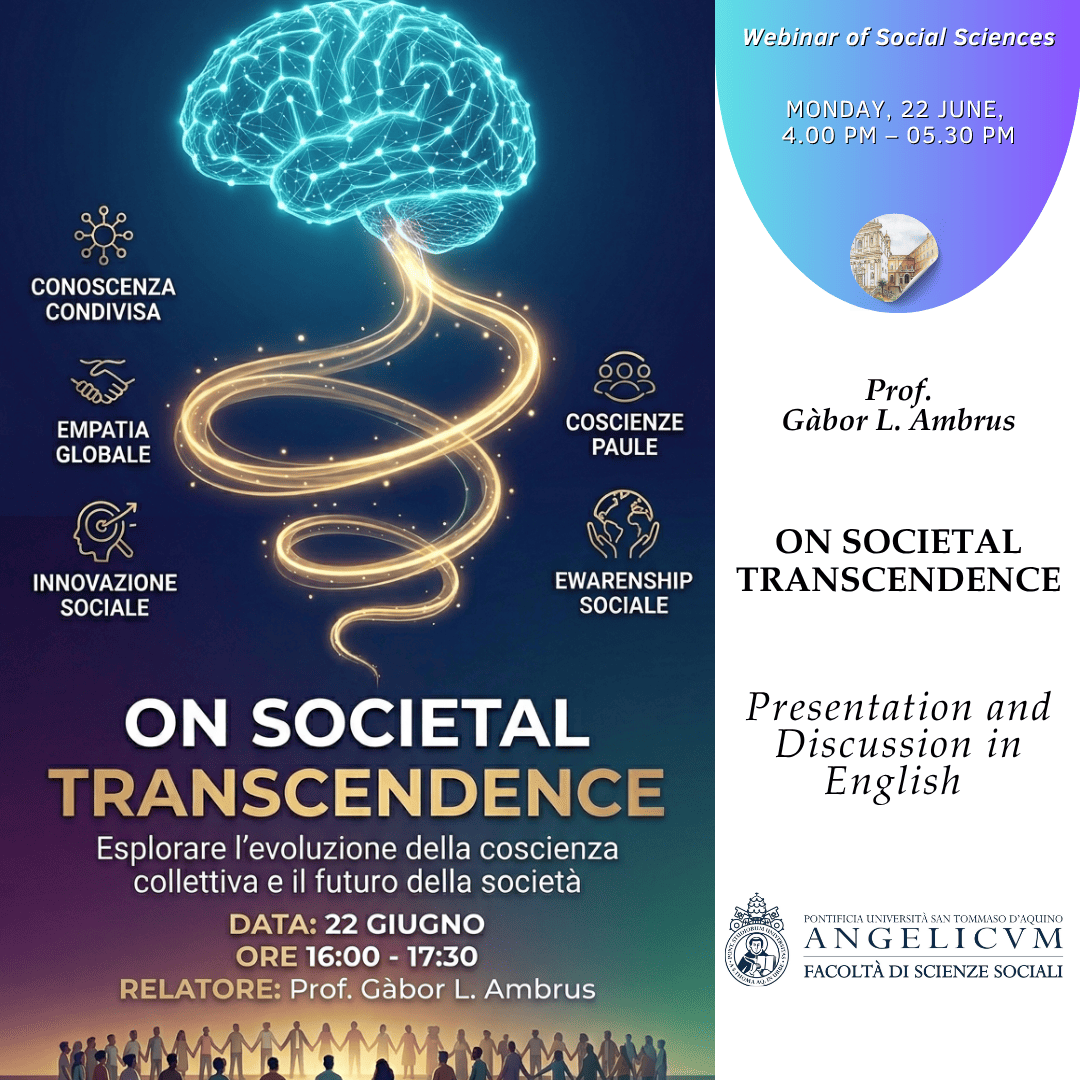
Monday, 22 June, 4.00 p.m. – 5.30 p.m.
Link: https://meet.google.com/tvf-fbjv-aho
Abstract
This paper argues that the vast shadowy apparatus of artificial intelligence and its applications today can be described as the opaque, inscrutable and unpredictable sphere of a ‘black box’ and thereby interpreted as an entity opening up something like a ‘societal transcendence’ within society itself. In a sense, ‘societal transcendence’ is the theological figure of ‘transcendence-in immanence’ applied to current social conditions. The transcendent sphere of AI is a faceless and inhuman force which poses various threats and causes universal unease. While deeply affected by this force, human existence is offered comfort in its ‘human bias towards the human’. This bias and this comfort manifest themselves in what can be called cultural ‘phantasmagorias’ of the human – a term which originates from Walter Benjamin’s descriptions of the collective dreamworld of 19th century capitalism and modernity. It would nevertheless be erroneous to think that only such phantasmagorias populate the whole of contemporary culture. There are films, TV shows, and works of literary fiction that exhibit the symptoms of ‘societal transcendence’ and of its faceless and inhuman quality. The great originator of this small segment of today’s culture is the prose of Franz Kafka which played a respective role in its own time.
Il presente articolo sostiene che il vasto e oscuro apparato dell’intelligenza artificiale e delle sue applicazioni odierne possa essere descritto come la sfera opaca, imperscrutabile e imprevedibile di una «scatola nera» e, in quanto tale, interpretato come un’entità che apre una sorta di «trascendenza sociale» all’interno della società stessa. In un certo senso, la “trascendenza sociale” è la figura teologica della “trascendenza nell’immanenza” applicata alle attuali condizioni sociali. La sfera trascendente dell’intelligenza artificiale è una forza senza volto e disumana che pone diverse minacce e provoca un malessere diffuso. Pur essendo profondamente influenzata da questa forza, l’esistenza umana trova conforto nella sua «predilezione umana per l’umano». Questa predilezione e questo conforto si manifestano in quelle che possono essere definite «fantasmagorie» culturali dell’umano – un termine che trae origine dalle descrizioni di Walter Benjamin del mondo onirico collettivo del capitalismo e della modernità del XIX secolo. Sarebbe tuttavia errato pensare che solo tali fantasmagorie popolino l’intera cultura contemporanea. Esistono film, programmi televisivi e opere di narrativa che presentano i sintomi della «trascendenza sociale» e della sua natura anonima e disumana. Il grande precursore di questo piccolo segmento della cultura odierna è la prosa di Franz Kafka, che ha svolto un ruolo analogo ai suoi tempi.
Short bio
Gábor L. Ambrus holds MA degrees in Classics and Hungarian studies (from ELTE, Budapest) and a PhD in Theology (from K. U. Leuven). He is postdoctoral researcher at the Angelicum, Faculty of Social Sciences and also at Charles University, Faculty of Protestant Theology (Prague). The main focus of his research is the present of the Christian tradition in the context of techno-scientific civilisation. Currently, he works on a project entitled ‘Artificial Intelligence and Contemporary Culture’.
Gábor L. Ambrus ha conseguito una laurea magistrale in Lettere classiche e Studi ungheresi (presso l’ELTE di Budapest) e un dottorato in Teologia (presso l’Università Cattolica di Lovanio). È ricercatore post-dottorato presso l’Angelicum, Facoltà di Scienze Sociali, e presso l’Università Carlo IV, Facoltà di Teologia protestante (Praga). Il fulcro della sua ricerca è la presenza della tradizione cristiana nel contesto della civiltà tecno-scientifica. Attualmente lavora a un progetto intitolato “Intelligenza artificiale e cultura contemporanea”.