IT
IT  EN
EN 

Artificial Intelligence, the Common Good and Business: Towards a bonum arduum Approach
Pierre Januard
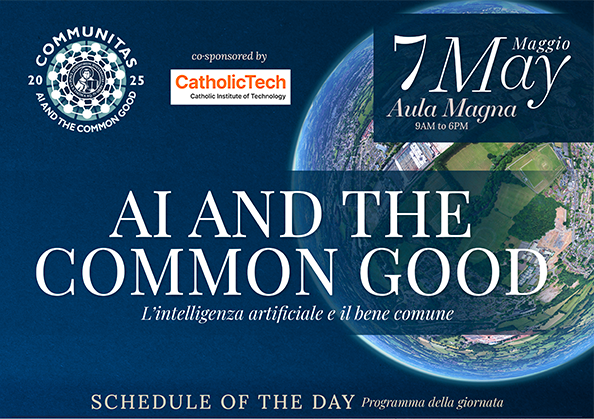
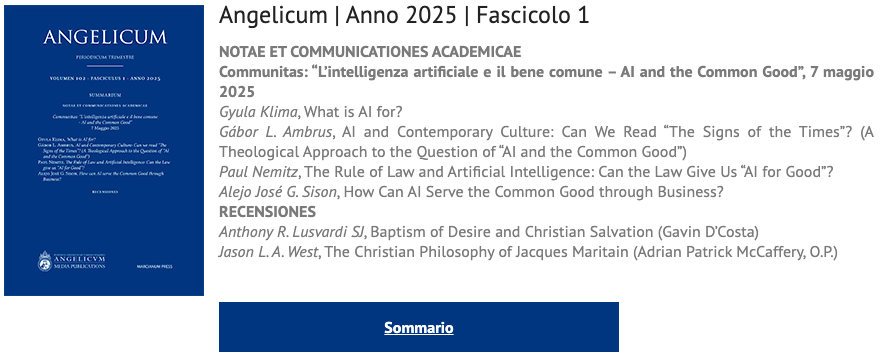
The development of Artificial Intelligence (AI) is leading to a rethinking of the common good in business. In this way, the contribution proposed by A. J. G. Sison at the Angelicum’s Communitas day 2025, “How can AI serve the Common Good in Business?”, is of significant interest, and can be extended by integrating the notion of the bonuum arduum (arduous good) used by Thomas Aquinas. To pursue this line of reflection, I will first emphasise the interest of Sison’s approach, then look at how the common good in business can correspond to a bonuum arduum in the sense intended by Thomas Aquinas, and then ask how AI can contribute to the bonum arduum that is the common good in business and whether AI itself can become a common good.
The Benefits of Sison’s Common Good Approach
First of all, Sison defines the common good. This is important because the concept is often used but rarely defined, even in Aquinas’s works. A common good is an object of inclination, tendency, or desire, or something that perfects humans and that can be achieved only if all the members of a group achieve it.
The common good is therefore something that is the result of a collective work. Everyone works together to achieve it. The emphasis here is on the process, the common action, rather than on the end, which would be the common good, even if we can assume that it motivates this common action. There is a common good if there is a “doing together”, a joint collaboration to achieve that good.
Business is a form of common good not (at least from this perspective) because it satisfies a universal need, but because the mode of production mobilises the common good. Sison promotes a production approach that emphasises social relations and the cohesion of stakeholders in production. This is an approach to economic activity based on the very interest of producing in a certain way, even before the need is met. This is echoed in social enterprises for the integration of vulnerable or disabled people.
Is the Common Good in Business a bonum arduum?
This production-based common good approach invites us to go further and to call upon the notion of bonum arduum used by Aquinas for describing the object of hope. A bonuum arduum in a good that is arduous (difficult to obtain), but still accessible, and which lies in the future (Summa theologiae, Ia IIae, q. 40, a. 1, resp.).[1] Aquinas does not apply this notion to the economy; however, it seems a helpful concept to describe the common good in that context.
Aquinas applies it allusively to work. Indeed, the object of labour is a good and is difficult to obtain (In II Sententiarum, d. 29, q. 1, a. 4, resp.; In III Sententiarum, d. 26, q. 2, a. 2, ad 3). However, it is John Paul II who clearly identifies labour and work with the bonum arduum, in emphasising the dual dimension of work as both arduous and dignified (Laborem exercens, 9, taken up by Sison, Ferrero and Guitián 2016, 512‒513).
The notion of the arduous good corresponds to economic activity by combining both risk and scarcity (Januard 2025). So does the activity that implements the common good, because it is an economic activity. Indeed, the common good in business is perhaps even more of a bonuum arduum than other economic activities, because it is possible but not certain that the good is common, that production is really a common work, and because the common good is a future result of a production process. We can thus conclude that to serve the common good in business is difficult, but possible, and is a process.
How can AI contribute to the bonum arduum that is the common good in business?
Today, AI in management is often used not for the common good; instead, it is used to spy on employees, to make them compete with each other and to assess individual productivity. However, Sison has shown that it can also encourage cooperative games and help overcome the difficulty of serving the common good in business. Pursuing this line, three ways can be highlighted according to which AI contributes to the common good in business.
First, AI can aggregate everything that stakeholders consider to be a good. The common good is more than the aggregation of everybody’s good; however, it constitutes a first step in a cooperative approach.
Second, AI can facilitate communication so that every word spoken is audible to others by stimulating them positively. What is at stake is not just linguistic translation but a psychological translation, since everyone has his own language and it is difficult to find the right words and gestures through which to reach others. AI may help managers to implement an accurate process of motivating, recognition and acknowledgement, and may help employees to adopt a reassuring attitude that facilitates relations with managers. In a more objective approach, it may also help to translate points of view, as each stakeholder not only has his or her own psychology, but also a specific point of view due to his or her position in the organization. AI may facilitate the expression of this point of view into compatible languages that are understandable by other stakeholders. In this way, AI can offer psychological support, helping all the stakeholders to develop more cooperative behaviour.
Third, AI may be used not for surveillance but for support. Instead of spying on employees and informing managers of shortcomings in the work of their subordinates, the machine can correct errors and teach how to do a task better; it can even, through the analysis of messages and productivity, detect personal difficulties (with health, in relationships, and so on) and the need for the person to be accompanied. As this touches on the boundaries of privacy, it must be strictly regulated by law, but these functions of monitoring work done can be adapted for the good of the person and the common good.
These functionalities resonate with the idea of a common good in business, which would be a bonum arduum because the interest in the event of success is indeed high, but success, i.e. the realisation of the common good, is not certain and remains future.
Could the use of AI itself become a common good?
We can go further and ask ourselves whether AI can itself become a common good in the production process, i.e. a good that benefits all stakeholders and is desired by all. Three conditions thus appear.
First, AI must be configured and controlled by all for the good of all. Everyone must see it as a good and be a stakeholder in the implementation of this good.
Second, AI must be able to contribute to the dignity of labour and work through support (remedying shortcomings through learning, detecting personal and professional difficulties, and supporting solutions) and recognition (in the language that suits everyone).
Third, this common good concerns all the stakeholders, not only those involved in production. While Sison focuses on the production process, we have to take into account another facet of the common good in business, i.e. goods produced for common use (a consumption approach to business). Production is then seen as a response to a need, and AI may then be a common good if it makes it possible to identify this common need.
To conclude, AI offers a multitude of opportunities to serve the common good in business, in particular, according to Sison’s approach, in what concerns the production process, particularly through the social relations that unfold within production. This common good resonates with the Thomasian notion of bonum arduum, which John Paul II already applied to work. In some respects, AI can even become a common good in itself. This will depend on how it is supervised and on the intentions of those who are to take it up.
References
Januard, Pierre. 2025. Thomas Aquinas’s bonum arduum applied to economics: towards a lexicon assuming scarcity and risk, working paper.
John-Paul II. 1981. Laborem exercens. Acta apostolicae sedis 73: 577–647.
Sison, Alejo José G., Ferrero, Ignacio, and Guitián, Gregorio. 2016. Human dignity and the dignity of work: Insights from catholic social teaching. Business Ethics Quarterly 26 (4): 503–528.
Thomas Aquinas. 1929–1947. Scriptum super Sententiis. 4 t. Paris: P. Lethielleux.
Thomas Aquinas. 1888. Summa theologiae, Ia, qq. 1–49. Edited by Leonina, n°4. Rome: Typographia polyglotta S. C. de Propaganda Fide, 1888.
Thomas Aquinas. 1895. Summa theologiae, IIa IIae, q. 1–51. Edited by Leonina, n°8. Rome: Typographia polyglotta S. C. de Propaganda Fide.
Thomas Aquinas. 1853. Super Psalmos. In Thomas Aquinas, Opera omnia n°14. Parma, P. Fiaccadori.
Thomas Aquinas. 1949. Quaestiones disputatae II, edited by P. Bazzi. Turin/Rome: Marietti.
[1] The expression “bonum futurum arduum possible” is found in Summa theologiae, Ia IIae, q. 40, a. 2, resp.; a. 5, resp.; a. 6, resp.; q. 41, a. 2, resp.; IIa IIae, q. 17, a. 1, resp.; a. 7, resp.; De virtutibus, q. 4 (de spe, q. 1), a. 4, resp.; Super Psalmos, Ps 17:2.