IT
IT  EN
EN 

Communitas 2025: Artificial Intelligence and the Common Good
Helen Alford
Communitas is an annual, bilingual, inter-faculty conference that brings together experts from the various disciplines of the Pontifical University of St Thomas (Angelicum) to present, discuss and explore a current topic of great importance. In previous years, the topics addressed have included: 'Preaching and the Arts'; 'Biblical Law and Natural Law'; ‘Are “just wars” possible?’; 'The Common Good or the Throw-Away Society?'; “What is a University?”.
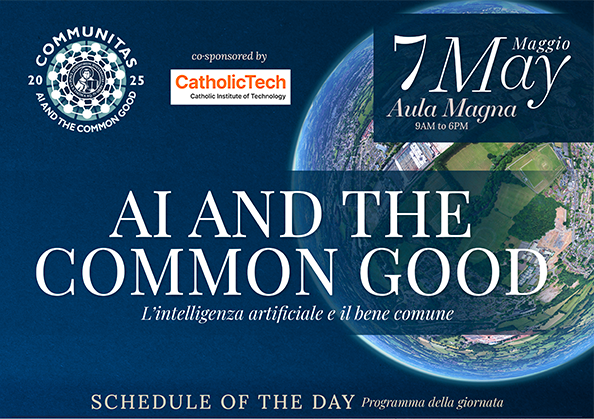
Communitas 2025, which took place on May 7 2025, addressed the relation between AI and the common good. We can understand the common good in at least two different ways. In a classic Christian, and Thomistic, approach, human beings have a nature and are naturally social; their good, or fulfilment, is achieved by realising the potentiality of that nature, which depends on, and contributes to, the fulfilment of the community, that is, to our common good. If we have this kind of idea of the common good, we are going to develop a different kind of AI from the form we would develop if we have the current mainstream idea of the common good. According to the current mainstream, the common good is no more than a means to allowing each one of us, as individuals, to achieve our own, individually-defined goals. AI developed within this idea of the common good may well be dangerous to us; indeed, our current discussions about it focus on regulation, that is, on limiting its negative effects.
The conference programme and other details can be found at: https://angelicum.it/event/communitas-ai-and-the-common-good/
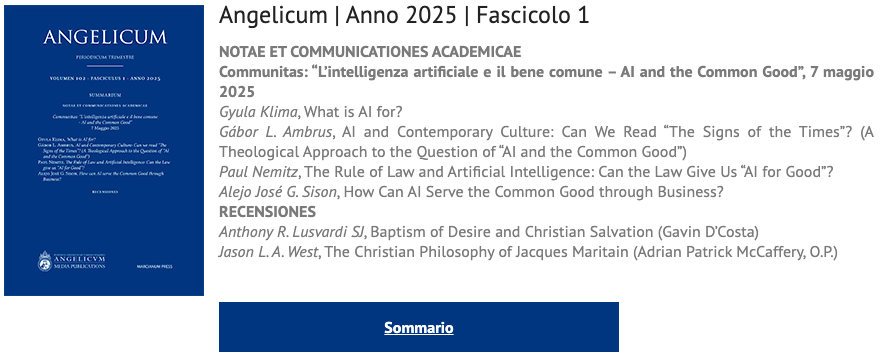
The main papers of Communitas 2025 will be published in number 1, of the journal Angelicum, coming out in 2025. In this issue of OIKONOMIA, we present other interesting material from the conference, as follows:
- The “concept paper” of the conference which was produced a year before the conference took place and shared with all the speakers, respondents, student panellists and break-out group leaders, so that they were all working within a shared conceptual framework.
- Two papers that either emerged from (Persico, Baggot and Di Pietro) or guided (Wijas) the work of the break-out groups. These interactive groups were organised around 4 topics, allowing students and other conference participants to take an active role in discussing the topic or, in one case, taking part in a live experiment.
- A short response (Januard) to the paper given by Prof Alejo Sison in the conference. Prof Sison is one of the leading thinkers applying the idea of the common good to business structures and practices.
- Three short papers by students who took part in the student panel, bringing their insights into the main conference debate.
Contributors
Helen Alford O.P., Gabor Ambrus, Prof. Michael Baggot, Silvia Di Piero, Vincenzo Grienti, Pierre Januard O.P., Luz Margarita Paredes, Tony Persico, PhD, Luis Francisco Hernandez Sanchez, Sebastian Wijas.